
Google's Nano Banana AI model now integrates directly into Photoshop Beta, offering superior detail preservation and more realistic results than Adobe's Firefly. This powerful generative fill tool excels at maintaining subject likeness while transforming backgrounds, clothing, and entire scenes.
The integration brings professional-grade AI editing capabilities directly into Photoshop's familiar interface, complete with advanced selection tools and workflow optimization.
Watch the Tutorial
Video by photoshopCAFE. Any links or downloads mentioned by the creator are available only on YouTube
Essential Tips for Nano Banana in Photoshop
- Use the selection brush with reduced hardness for smoother edge blending and better texture matching
- Keep generated areas moderately sized to maintain 1K resolution quality—avoid selecting entire images unless necessary
- Access Nano Banana through Generator Fill by switching from Firefly (FI) to the Gemini 2.5 model option
- Combine traditional Photoshop tools with AI generation for precise control over final results
- Download Photoshop Beta from Creative Cloud Apps to access this feature, as it's not available in the standard version
Related Articles and Tutorials about AI Image Editing
Explore more AI-powered Photoshop techniques and comparisons.
Gemini Nano Banana vs Photoshop: A Detailed Performance Comparison
Modern AI tools promise instant photo editing magic with simple text prompts. Gemini's Nano Banana and similar platforms can generate impressive results for basic tasks, but professional work demands precision and consistency.
This comprehensive comparison tests AI capabilities against traditional Photoshop techniques across skin retouching, compositing, background removal, and photo restoration to reveal where each approach excels.
Watch the Video
Key Insights from AI vs Photoshop Testing

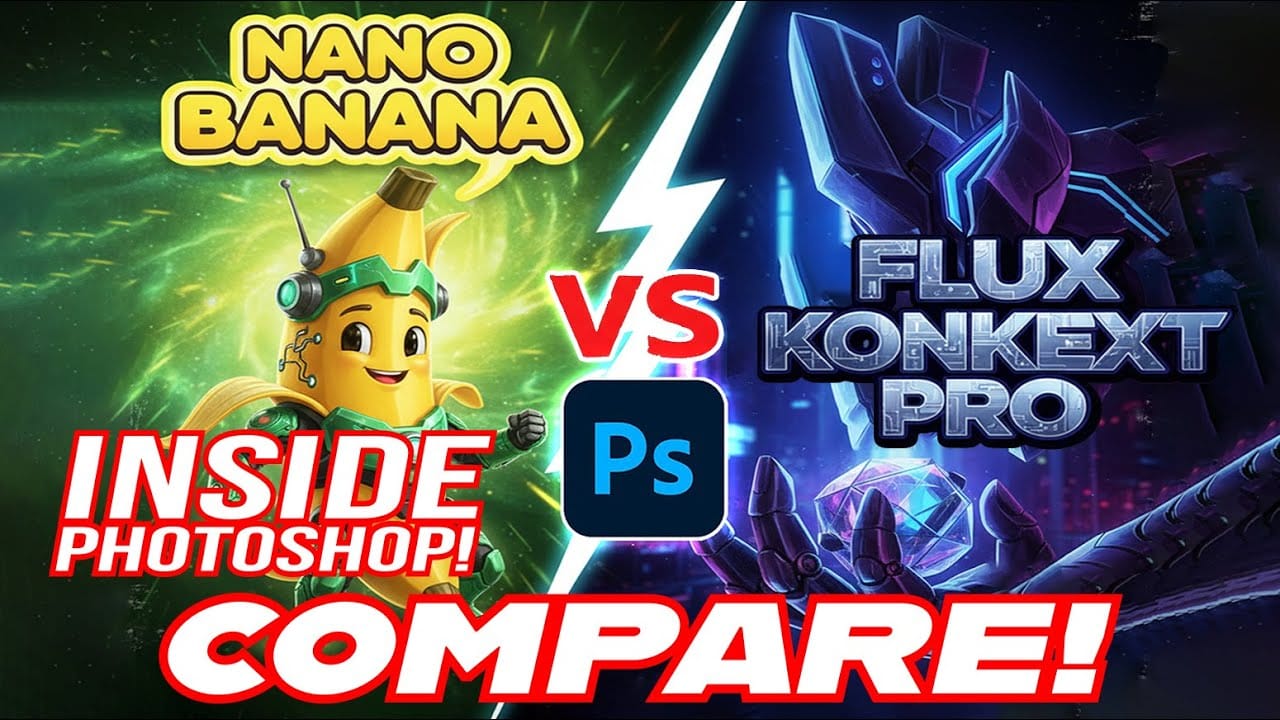
Photoshop AI Comparison: Nano Banana vs Flux Kontext Pro Performance Test
Two powerful AI models now compete within Photoshop Beta: Nano Banana and Flux Kontext Pro. Each handles image generation differently, excelling in specific scenarios while struggling with others.
This comprehensive comparison reveals which model performs better across various editing tasks, from facial expressions to text generation and seasonal transformations.
Watch the Comparison
Practical Tips for AI Model Selection
* Use a softer selection brush to minimize image sliding glitches co
Photoshop Roadmap Weekly #13
This week, Colin Smith from Photoshop Cafe breaks down the top new features in Photoshop's May 2025 update, plus how AI is transforming editing workflows. We've got new tutorials on dispersion effects, dynamic text, text portraits, and redesigning a classic Star Wars poster. You'll also discover 5 hidden Photoshop features and a trick to boost your social media views. Don't miss your freebies: 5 hypercolor liquid paint backgrounds from Color Tides and 7 retro paper textures to add vintage flair
TOP New Features in Photoshop – May 2025 Update
Many Photoshop users frequently encounter common challenges such as time-consuming manual selections for complex objects, difficulties in achieving precise color adjustments across an image, or struggling with inconsistent results when removing unwanted elements like reflections. These hurdles often slow down the creative process, making it frustrating to achieve a desired professional look efficiently.
This guide explains how Photoshop's latest updates introduce powerful new functionalities, i